Wednesday, March 2, 2011

What will Thailand do... Shoot the "foreign" military ataches?

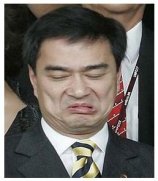
Yellow-shirt activist Veera Somkwamkid (left)
and Democrat MP Panich Vikitsreth

Cambodian move raises border tension

A Cambodian bid to take a group of foreign military attaches into part of the disputed 4.6 square kilometres around Preah Vihear temple has raised tension, again, on the border in Si Sa Ket province, a military source said on Wednesday.

The source said that Thai troops were put on a continuing alert in the 4.6 sq-km area, especially around the Preah Vihear temple, as a precaution, from Tuesday night.

The tension flared after Cambodia informed the Thai soldiers that it planned to bring the military attaches of 10 countries from Phnom Penh into the disputed area on Wednesday. The Thai side denied them permission.

Cambodia wanted the attaches to see important spots, including the damage to Wat Kaeo Sikha Kiri Savara and the area around it, which is in Thai terrority, the source said.

"There would be no problems if the attaches were taken specifically to see Preah Vihear temple,  but we cannot allow them to go into the disputed area which has been occupied by Cambodian soldiers. We also regard the disputed area as ours," said the source.

The source said when Thailand took military attaches of 14 countries to the border in the middle of last month; they were taken to see only Mor E-daeng cliff and Phum Srol village on the Thai side of the border. They did not enter the disputed area.

The rejection caused Cambodia to postpone the visit until Thursday. Thai troops have been put on the alert. It was not known whether Cambodia would persist with the visit or cancel it, the source said.

The source said the Thai military attaché in Phnom Penh had contacted the military attaches of other countries and been told they wanted the visit postponed for fear of sparking a new confrontation between Thailand and Cambodia.

Meanwhile, reports reaching the Thai military said Cambodian Prime Minister Hun Sen had ordered a change to the border forces, replacing the current soldiers with those of the Khmer Rouge.

The source said Khmer Rouge soldiers were viewed as intended more for combat than for promoting a good relationship.

Democrat Party MP Panich Vikitsreth said the health of yellow-shirt activist Veera Somkwamkid, who is imprisoned in Cambodia, is deteriorating.

Mr Panich, one of the seven Thais arrested by Cambodian troops on Dec 29 last year for illegal entry, said Mr Veera had a head injury, skin rashes and respiratory illness due to poor air circulation in his cell.

The MP said he had talked with the mothers of Mr Veera and his secretary Ratree Pipatanapaiboon, who is also detained in Phnom Penh. Both mothers were concerned for Mr Veera and Ms Ratree and wanted them to be released as soon as possible.

The quickest way to get them released was to petition the Cambodian monarch to grant the pair a royal pardon, he said.

Mr Panich said he hoped the case of Mr Veera and Ms Ratree would be treated similarly to the case of Thai engineer Sivarak Chutipong who was granted a royal pardon by Cambodia's King Norodom Sihamoni before serving the usual two-thirds of his sentence.

Mr Sivarak was found guilty of stealing the flight plan of former prime minister Thaksin Shinawatra ahead of his visit to Cambodia in 2009.

The Phnom Penh Municipal Court on Feb 1 jailed Mr Veera for eight years, and Ms Ratree for six years, after they were found guilty of illegal entry and espionage on Dec 29.

Tuesday, March 1, 2011

Secratary Dean Acheson and Preah Vihear


It was then the  former U.S. Secretary of State Dean Acheson who acted as attorney for Cambodia in the country's legal battle in the International Court of Justice with Thailand over the ancient border temple of Preah Vihear.

Move on Mark A. Vejjajiva and be a better man--Thanarat did the right thing.

Mark Abhisit Vejjajiva should have more dignity as an educated man in modern times.
The Preah Vihear case is over and done with since 1962 when the World Court decided and when then Thailand Prime Minster Sarit Thanarat’s government agreed with the verdict of the World Court: Preah Vihear and its surrounding belonged to Cambodia.
On the left is the image at: www.safran-arts.com/sarit-thanarat.html

No one is crazy enough to believe that the World Court only awarded the "Temple" or "the monument" to Cambodia without the surrounding land.  Mark, you have made a fool of yourself.
It’s natural that any person or persons who lost in court would feel bad and disagree with the decision, but a man with dignity would live by such a decision and move on.  Prime Minnister Sarit Thanarat and many of his ministers reportedly wept over the decision, but they accepted the verdict with dignity. The case was closed!
According to the attached report (http://www.box.net/shared/3f0yyv84ve) Sarit told newsmen the Thai government's decision was based on a desire to "maintain our fine reputation in international affairs."  In the eyes of good men, it means that to accept the World Court’s verdict was the right thing to do for Thailand and for the world.
In this matter, Sarit Thanarat was a better man than Mark A. Vejjajiva -- an elite Thai with a PhD --who has been using the emotions of some yellow-shirt extremists to demonize himself, the Thai King as well as Thailand.  
Move on Mark.  It was the wrong move by Thailand from the beginning.  What Thailand have done here is to help put Premier Hun Sen , whom some of you have called him as “a bully boy next door “ on the pedestal and make him a hero and Cambodia the champion of ASEAN.  
Remember this; Premier Hun Sen may be “a bully boy next door” for Thailand but, it is the Khmer Temple of Preah Vihear that makes all Khmers unite behind him.  

Monday, February 28, 2011

Polictics and the money trails: Putting the country first? Or Money first?

It is getting harder and harder for Cambodian voters to trust Cambodian politicians.
Defection is a normal way of political life for scores of oppositions’ members. Sometimes they defect to find a better position in a different party, other time they defect because they want a government’s position.

        From    To
What was known as political principles or party’s loyalty cease to exist. People are not suprised any more and they expected to see more accusations and difections before and after the next general election. Stay tuned!     
========

Funcinpec defection

An outspoken member of the Funcinpec party’s central committee has announced plans to defect to the Norodom Ranariddh Party after lodging multiple corruption allegations against Funcinpec secretary general Nhek Bun Chhay.

Phan Chantha, who formerly served as a Funcinpec lawmaker, said today that he had “no confidence” in the royalist party’s current leadership.
“How can I work with these kinds of people?” he said.
“I am poor, but my ideals are not poor and are not corrupted.”
Phan Chantha alleged last month that Nhek Bun Chhay had improperly mortgaged Funcinpec headquarters in Phnom Penh and had later sold the property for US$3.85 million without consulting the rest of the party’s leadership.
“Acting like this is not suitable for a party leader. I am not afraid of being fired from the party and I dare to be responsible before the law,” Phan Chantha said at the time.

Ranariddh was himself ousted from Funcinpec in 2006 in connection with allegations that he embezzled funds from the sale of the party’s headquarters.

He announced his comeback to politics in December of last year after having retired in 2008.
Nhek Bun Chhay, who is also a deputy prime minister, said today that Phan Chantha’s defection was a “good thing” for Funcinpec because the fiery central committee member was no longer committed to the party’s platform.

“It’s good that he’s defecting because he has been living with Funcinpec but serving the Norodom Ranariddh Party,” Nhek Bun Chhay said.

Nhek Bun Chhay said last week that he was planning to file a lawsuit against Phan Chantha and two other members of the Funcinpec central committee, accusing them of fabricating contract documents that suggest he was paid to use his political influence on behalf of a Chinese telecoms company.

The deputy prime minister said today that he no longer held such plans, but added that he would follow through with the lawsuit if the trio continue to “defame” him.
 
http://www.everyday.com.kh/non_members/channels/news/khmer/2011/03/05l_22702_funci.htm

Another Evidence: Did Thai build this Khmer Temple?

About 34 Kms from Surin on Thailand’s Route 226 (Surin-Sikhoraphum) there stands an ancient Khmer Prasat called Prasat RoNgeang.


Thailand earns 40 Baht per person/visit. This Ancient Khmer Prasat earns thousands of dollars each year for the Thais.

Thanks to our Khmer ancestors who built this monument somewhere around the Angkor era in which Thailand didn’t exist yet.

The people of the world can witness this as historical evidence that Surin was Khmer territory and that Thailand should appreciate Khmer people and their artworks as well as their heritage and must stop its aggression towards Khmer.


Thailand must leave Preah Vihear and other Prasats along Thailand-Cambodia borders to their righteous owners—the Khmers.

Another Evidence: Did Thai build this Khmer Temple?

The World is Watching: Is UNESCO neutral?

The world is watching to see if Thailand can bully UNESCO to get what it wants. De-listing Preah Vihear from the Unesco World Heritage Site is one of Thailand's demands.

While Thailand has 5 sites listed, Cambodia is lucky enough to have only two-- Angkor and Preah Vihear.

Preah Vihear belongs to Cambodia and the world community. Instead of looking for ways to destroy Prasat Preah Vihear, Thailand should be proud of Ancient Khmer Arts and Temples like they have been for those hundreds of Khmer Temples in Thailand. Thai people and the people of the world have enjoyed them for many decades. Instead of using its mighty gun power to damage Preah Vihear, Thailand should help preserve it.

In the long run, Thailand and Thai citizens who live nearby this beautiful site will endlessly benefit from Preah Vihear.


                    Both Pictures are courtesy of Sambath Meas, the Author of The Immortal Seeds
                                                http://sambathmeas.blogspot.com/


                                  Wat Keo Sikha Kiri Svara-before Thai's Invasion
==========================================
From: http://english.cri.cn/6966/2011/02/28/2743s623182.htm

Koichiro Matsuura, special envoy of the United Nations Educational, Scientific and Cultural Organization (UNESCO) said on Monday that it is impossible to de-list Preah Vihear temple from the World Heritage List.

Matsuura made the remarks during a meeting with Cambodian Prime Minister Hun Sen.

"Thailand has intention to ask UNESCO to de-list the temple, but I had informed Abhisit Vejjajiva (Thai prime minister) and Kasit Piromya (Thai foreign minister) that de-listing of Preah Vihear temple from the World Heritage List is impossible by all means because Preah Vihear temple is the outstanding universal value,"the Prime Minister's spokesman Eang Sophalleth quoted Matsuura as saying.

"Preah Vihear temple, the World Heritage site, is under the responsibility of UNESCO, so UNESCO experts will come to evaluate and restore Preah Vihear temple in the future,"Matsuura told the premier.

Meanwhile, Hun Sen informed Matsuura that Thai troops had fired more than 400 shells of mortars and artillery at the temple which caused serious damages to the World Heritage site. The premier also asked the World Heritage Committee (WHC) not to halt the temple's management plan during its annual meeting in Bahrain in June.

"The management plan of the temple by UNESCO on the World Heritage site should not be abandoned due to the threat of Thailand,"Hun Sen said, adding "if we don't do urgent repair, Preah Vihear temple will be in danger. Moreover, it will set a bad precedent that big country's threat made UNESCO unable to manage and preserve the world heritage site."

The Bangkok Post, on Feb. 26, quoted Thai Prime Minister Abhisit Vejjajiva as saying that Matsuura supported Thai stance to put off Cambodia's management plan of Preah Vihear temple.

Matsuura told reporters after the meeting that"UNESCO is not sided with any country, it is neutral."

Matsuura, a former director-general of UNESCO (1999-2009) and a former Chair of the World Heritage Committee, was named by Irina Bokova, director-general of UNESCO, on Feb. 11 as the special envoy to mediate the issue of Preah Vihear temple following a deadly clash from Feb. 4 to 7 between Cambodian and Thai troops over the border disputed area next to the temple. He arrived here on Sunday to pay a three-day visit.

The clash unleashed a barrage of artillery shells on both sides of the border, killed and wounded some soldiers and people of both sides, as well as caused serious damages to Preah Vihear temple.

Preah Vihear Temple was inscribed on the World Heritage List in 2008.

The conflict has occurred just a week after the inscription due to Thai claim of the ownership of 1.8 square miles (4.6 sq km) of scrub next to the temple, since then periodic clashes have happened between the two countries' troops resulted in the deaths of troops on both sides.

Unesco Rep Meets Cambodian Officials Over Preah Vihear Temple (NTD TV):
http://english.ntdtv.com/ntdtv_en/news_asia/2011-02-28/unesco-rep-meets-cambodian-officials-over-preah-vihear-temple-dispute.html

A piece of history: Knowing where the Thai or Siamese came from

The below piece of history are from : http://whc.unesco.org/en/list/574. 

It is about Sokhothai, but the proof is there that before "Sokhothai" all ancient temples including Prasat Preah Vihear were built by the Khmers.

==============

Brief Description

Sukhothai was the capital of the first Kingdom of Siam in the 13th and 14th centuries. It has a number of fine monuments, illustrating the beginnings of Thai architecture. The great civilization which evolved in the Kingdom of Sukhothai absorbed numerous influences and ancient local traditions; the rapid assimilation of all these elements forged what is known as the 'Sukhothai style'.
 

Historic Town of Sukhothai and Associated Historic Towns © Nomination File 

Long Description

The small historic park of Sukhothai (3.38 km2) constitutes a masterpiece of the first Siamese architectural style. The three sites are representative of the first period of Siamese art and the creation of the first Thai state.

Beginning in the 12th century, a people from Yunnan in China settled in the northern regions of the Khmer state. Known as the Thai (free men), they organized themselves in small communities. A Thai prince married a Khmer woman, then rebelled against the central power and created the first Siamese state, calling it the kingdom of Sukhothai after the name of its capital city. Ramkhamhaeng (or Rama the Strong), second son of the founder of the state (c. 1280-1318) was one of the most important Thai sovereigns, for he brought his state extensive territory through his military victories. He invented the Siamese alphabet (Khmer script) and imposed strict observance of the Buddhist religion and instituted a military and social organization copied from his vanquished neighbours, the Khmers.

The great civilization which evolved in the kingdom of Sukhothai was a tributary of numerous influences and ancient local traditions, but the rapid assimilation of all these elements forged, in record time, what is known as the Sukhothai style.

Three old towns were the principal centres of the kingdom of Ramkhamhaeng: Sukhothai (the capital), Si Satchanlai (second royal residence), and Kampheng Pet. In their architecture, built from brick with decorations in stucco and wood, they offer a great variety and skilful mixture of elements inspired by the Singhalese or Khmers. The great meeting rooms with the massive chevet decorated with a monumental portrait of Buddha are specific to Sukhothai architecture and subsequently influenced all Thai art. Among the statuary, the first Thai style is distinguished by the particular physical features of the Buddhas: a long, fine nose, a flame-like protuberance on the head (Sinhalese influences) and a double line around the mouth (Khmer tradition). Buddha is often represented upright (walking), his clothing clinging to his body, with an almost haughty attitude.

The historic town of Sukhothai lies a dozen or so kilometres from the modern town and still has a large part of its fortifications. The principal monuments include the monastery (wat) Mahathat, with its royal temple and its cemetery; Sra Si Wat, with its two stupas, their graceful lines reflected in the water of the town's biggest reservoir; and an impressive prang (reliquary tower typical of Ayutthaya art) from a somewhat later period. The site has been excavated and studied since the mid-20th century. In 1988 a 70 km2 area was declared a historic park. Unfortunately, a modern road was built and cuts the site in two.

The historic town of Si Satchanm, famous for its ceramics, is separated from the modern town by the river Yom. Among the 140 buildings on the site the most notable is the monastery of Chedi Chet Thao (temple with seven points), impressive with its seven rows of elongated stupas, erected to hold the ashes of the governors of the town. Since 1983, the site has been classed as a historic park (45 km2).

The historic town of Kamohena Pet (wall of diamonds) played mostly a military role and, even after the fall of the kingdom of Sukhothai, retained strategic importance. For this reason, its monuments are as much in the Sukhothai as in the Ayutthaya style. In 1980 the site was declared a historic park.

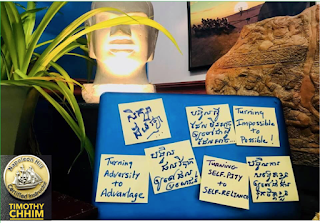
Turning Adversity to Avantage

Napoleon Hill says "definiteness of purpose is the starting point of all achievement," and my personal definiteness of purpose...