Friday, March 4, 2011

Learn About Our Neighbors: Thailand's troubles can trouble Cambodia


Key political risks to watch in Thailand-FACTBOX

Wednesday March 02, 2011 12:41:08 AM GMT
 Reuters

THAILAND-RISKS/ (FACTBOX)
By Martin Petty 

BANGKOK, March 1 (Reuters) - Thailand is bitterly polarised. Rivalries between several powerful camps remain deeply entrenched and there is no end in sight to a long-running political crisis.
Prime Minister Abhisit Vejjajiva says an election will probably take place around the middle of the year and although all sides welcome the polls, the stakes are high and there remains a strong possibility the results will be disputed.

Thailand's export-led economy is looking good, with growth of 7.8 percent last year, projected to expand 3-5 percent in 2011, although rising inflation remains a risk. 

The baht currency has weakened following an 11 percent gain in 2010, which hurt exporters and sparked fears about imposition of capital controls.

Following is a summary of key Thailand risks to watch:

POLITICAL INSTABILITY
A colour-coded political conflict, broadly pitting "red" urban and rural poor against "yellow" royalists, urban elites ,bureaucrats and the military top brass, shows no sign of resolution.


Despite a government-backed move to reconcile the differences, divisions still run deep and a powerful "red shirt" protest movement believes justice is still elusive in Thailand and continues to accuse powerful elite aristocrats and the military of meddling in politics and the judiciary.


Thailand has had six heads of government and several disruptive showdowns since a bloodless coup ousted tycoon Thaksin Shinawatra as premier in 2006.


The country has since been plagued by bouts of paralysing, at times violent street protests, the occupation of government offices and international airports, bombings, arson attacks, assassination attempts and clashes between troops and demonstrators.


The yellow-shirted People's Alliance for Democracy (PAD) is holding a small but prolonged protest over the government's handling of a long-running border dispute with Cambodia, although analysts believe this is aimed more at political gains or attempts to rekindle its popularity.


The Thaksin-allied United Front for Democracy Against Dictatorship (UDD) or "red shirts" have held four peaceful rallies of more than 30,000 people this year, showing the movement is still a political force to be reckoned with. However, it appears to have softened its stance since the Feb. 22 release on bail of leaders charged with terrorism, and says there is no need to hold more protracted rallies. It says it will respect the election result -- whoever wins -- as long as the vote is fair.


The government has also softened its stance and is allowing the protests to take place, peacefully, but has invoked an Internal Security Act to keep them under control.


The latest upheaval began with mass red shirt rallies last March. The protesters then occupied a huge swathe of downtown Bangkok for 10 weeks until driven out by troops on May 19. The death toll from Thailand's worst political violence in recent history was 91 with more than 1,800 wounded.


The government also appears reluctant to press the military to reveal details about is operations during the red shirt rallies. A preliminary probe by Thailand's Department of Special Investigation, leaked to Reuters, shows troops may have played a bigger role in civilian deaths than the authorities have admitted.


What to watch:
-- Changes in rhetoric by protest groups. The red shirts say they will protest peacefully and see no reason for blockades. However, they are still demanding the release of scores of detained demonstrators and a transparent investigation into last year's violence. If their wishes are not granted, they may reverse their pledge.


Though small in number, the yellow-shirted PAD has shown it can mobilise big crowds. If it carries out veiled threats to occupy Prime Minister Abhisit Vejjajiva's offices, trouble could be ahead.


-- General election. A nationwide poll is unlikely to solve Thailand's troubles and may indeed intensify them. Puea Thai, a proxy party for Thaksin, could win, as his allies have every election in the past decade. This might be unacceptable to the "yellows" and many in the military, making heated protests, or even a coup, possible. If Abhisit prevails and the poll is tainted by cries of foul play, the UDD could stage more crippling and potentially violent rallies and the military would be expected to take a tough line.


-- Court cases. Prosecutors are pushing ahead with terrorism cases against UDD members and leaders while probes into the siege of Bangkok's airports by yellow shirts in 2008 are moving slowly. A public perception of unfair verdicts would underline one of the key grievances of the red shirts: Double standards in justice.


POLITICISATION OF THE MILITARY
Thailand's military and police are deeply entwined with politics. The country has had 18 actual or attempted military coups in 79 years of on-off democracy. The military's last spell in direct charge of Thailand, after the 2006 coup, is widely regarded as an economic disaster.


What to watch:
-- Divisions in the military. The top brass back the government, having played a big role in putting together the coalition. But there are some cracks along similar yellow-red fault lines as in society and if this were to intensify, a split in one of Thailand's most solid institutions would be bad news.


-- Rumours of coups. The military's powerful stake in politics means they come around often, and worry markets, though a putsch remains highly unlikely at present.


-- General Prayuth Chan-ocha. The royalist, pro-establishment army chief has a zero-tolerance approach to the red shirts, having been involved in many operations against them.


INFLATION

The Bank of Thailand sees inflation as the key risk factor for Thailand's economy in 2011.
The central bank has raised its key policy rate by a quarter point to 2.25 percent, its fourth increase since July 2010, to curb inflationary pressure and economists expect a similar rise when it meets on March 9. The central bank said it sees no reason not to continue tightening. Annual headline inflation was steady at 3.03 percent in January while core inflation eased to 1.32 percent from 1.4 percent in December.


What to watch:
-- Increases in food prices, domestic consumption. This would push inflation up. The government has fixed prices of about 30 food items and has ordered producers of major consumer products not to raise prices of goods. There are plans to extend government food subsidies until June. Any change in these policies could raise inflationary pressure.


THE KING'S HEALTH
The 83-year-old King Bhumibol Adulyadej has been in hospital since September 2009. The most recent footage appear to show him in better health and the prime minister met the king on Feb. 22 and said his health was "fine". However, his illness has focused attention on what will happen when his reign comes to an end.
A key issue in Thailand's political conflict is what role the monarchy and unelected elites should have in running the country. King Bhumibol is respected in Thailand and his political influence is accepted by most Thais, but leaked diplomatic cables show doubts among key royal advisers about the suitability of his son and heir, 58-year-old Crown Prince Maha Vajiralongkorn. Many Thais and political analysts fear if the crown passes to Vajiralongkorn while political divisions remain, opposing factions will intensify their struggle.


What to watch:
-- Statements from the palace on the king's health. A troubled succession could have a major negative impact on stocks and the baht and raise the risk of a sovereign downgrade.
-- Public criticism of privy council members. Protests against the royal family are illegal, but some have dared to criticise palace advisors, suggesting succession may be less smooth than many hope.
(Editing by Daniel Magnowski)


Thursday, March 3, 2011

A talking monument : Prasat Muang Singh

Some time during the 13th century, when our Khmer Empire ruled most parts of the present day Thailand, among many monuments throughout the Empire, Khmer ancestors built a beautiful Prasat called Muang Singh. The Khmer ruins of Muang Singh sits beside a river now named Khwae Noi.

                                                   Pictures :wat-thai-temple.blogspot.com 

Unbelievably this Khmer Prasat can talk. It talks better than some modern Thai historians do. It tells the world that Kanchnaburi or Kanchanak Borei was one of the Khmer Empire's provinces. This Province was the westernmost point of Khmer Empire, it borders with the current day Burma or Phumea in Khmer.


Did I hear that someone had moved this Prasat from Cambodia to Thailand's border with Burma?


The Power of Money--will it last?

The Power of Money

If you think rich people and poor people have the same power or the same right in our
society, think again. 


Whether it is in legal or in political process, the poor or the underprivileged just don’t have a leg to stand on. The riches can almost always buy themselves out of their troubles and get away with many things in which the poor can only dream of doing.
   
If one is rich and powerful, he or she can easily find the most qualified attorney to represent him or her in court and or can simply bail him or her out and yet continues to enjoy normal life without much fear.  Most of the time, money can buy personal justice, physical freedom, individual titles, love and friendship, etc… 


From:
http://en.wikipedia.org/wiki/O._J._Simpson_murder_case
In politics, if a person or a political party lacks funds, the hope or chance for fruitful outcomes from the electoral processes is slim to none.  

If a politician has no money, his/her views will not be heard or respected. He or she has little or no clout in his/her political organization. With money a political person (a politician) or a political party can buy votes, can attract more members, and can stand toe to toe with their opponents and get their voices heard louder.

Without money an event like this (below) cannot be organized. 
(Military personnel and members of Cambodian People's Party (CPP) participate in a ceremony marking the 30th anniversary of the fall of the Khmer Rouge regime at the National Stadium in Phnom Penh on January 7, 2009. Tens of thousands of Cambodians cheered for the 30th anniversary of the ouster of the brutal Khmer Rouge regime at an elaborate stadium ceremony mounted by the country's powerful ruling party January 7.)
In July 2008, I had the opportunity to experience the real Cambodian politics when the lack of money was our main problem.  Although I wish to see honesty, loyalty, competence, and real democratic processes within the organization, I realized that only piles of money could talk. Money could qualify incompetent and disloyal persons to become the country political leaders and lack of it could disqualify skillful, knowledgeable and faithful people from participating in the process to help re-build our country.

The lack of funding forced us to limit our electoral campaign. This old truck, could not get us where we needed to be.


Individual countries in the world are no different from individual people on earth.  Rich and powerful countries can demand (not command) more respects from other countries than those poor and weak ones.  The rich and influential countries can get to do what they desire and in some cases they may violate international laws and yet be able to find ways to justify their abuses.
 

© Chumsak Kanoknan/Getty Images

Needless to say the rich and powerful monarchs can acquire love, worship and respect from their subjects. They can certainly persuade their government officials and politicians to help achieve their personal and national objectives.

In contrast, some poor monarchs are subject to tremendous domestic and foreigner's pressure.

http://www.financialexpress.com/news/thai-king-is-the-worlds-richest-monarch/352359/
Thai King Bhumibol Adulyadej is the world's richest monarch with a personal fortune worth USD 35 billion, according to the 'Forbes' magazine.
" Forbes said that the 80-year-old Thai King's estimated net worth increased sevenfold during the past year because of the transparency of his riches which include over 3,000 acres of prime real estate land in Bangkok, a stake in a major bank and huge holdings in the Siam Cement company.
In fact, King Adulyadej, the world's longest-reigning monarch, reached the helm of the US-based magazine's list of 15 richest rulers by knocking Sultan Haji Hassanal Bolkiah of oil-rich Brunei off the top spot. Forbes rated the personal fortune of the 62-year-old Asian Sultan -- who fell to the number four slot -- at USD 20 billion, adding that Brunei's oilfields were in the danger of drying up." (clipped from  PTI - The Press Trust of India Ltd.August 22, 2008 )

Read more at:
http://www.forbes.com/2009/06/17/monarchs-wealth-scandal-business-billionaires-richest-royals.html
=========

On the other hand, the poor and weaker countries in the world--especially those countries that are run by undignified leaders or those which lack unity--are less (or not at all) respectful, being looked down upon and or being kicked around like a soccer ball. 

Cambodian leaders, whether they are government officials or political leaders should learn too that while the power of money can be used to suppress people, buy votes, buy their heart, buy themselves nicer villas, demand people’s respects but at the same time money can divide, destroy or bring them and our country down to a level that other countries will continue to kick Cambodia around.


With the uprisings throughout the world even the richest man of India is worried about the "two indias."India’s Richest Man Worries About Other India:
Speaking to a gathering of Indian businessmen and top officials on Tuesday, Mukesh Ambani, chair of Reliance Industries Ltd., was found to be riding the India-not-so-shining car, offering listeners an idealistic speech that called for industry to work to unite the “two Indias.”
http://blogs.wsj.com/indiarealtime/2011/03/01/india%E2%80%99s-richest-man-worries-about-other-india/?mod=google_news_blog


In Cambodia, all Khmer people need to help improve Cambodia's image to earn respects from the international community as well as from ourselves. There are rooms to help develop in all areas.  Unity among us is one of the challenges that face us now and in the future. Our advantages are that we have learned many times in the past that what has destroyed us thus far is the absence of unity. The split between then Prince Sihanouk and Marshal Lon Nol in the 1970, for example, has resulted in millions of Khmer lives.

The current democratic processes in Cambodia need to be improved at faster pace in order to avoid a possible all out public protest and to ensure that all Khmer citizens' voices are being heard without any distortions. In addition, political leaders of all parties need to put our "country first"--not their "money first, sex second and party third (or Luy lekh muoy, Sex lekh pii, Party lekh beiy)" as the new saying cited by many Cambodians in Phnom Penh streets.   
What we have seen around the world lately is not a pretty sight. Collectively, people are trying to win or take back their rights, freedom and justice. It is proven that the power of money, especially the money earned from dishonesty, does not last forever. With modern technology and communication system, people are catching up rather quickly about what is going on in the world. Sooner or later they will learn that they have nothing to lose by aggressively demanding for their fair share.

To change Cambodia's future from plunging into the abyss, all of us need to do good or better things and we have to do them fast. 

Wednesday, March 2, 2011

Learn About Our Neighbors: Thailand Military Strength

Thailand Military Strength

28
Map of Thailand


PERSONNEL
Total Population: 65,493,296
[2008]
Population Available: 35,304,678
[2008]
Fit for Military Service: 27,027,453 [2008]
Reaching Military Age Annually: 1,042,603 [2008]
Active Military Personnel: 314,000 [2008]
Active Military Reserve: 200,000 [2008]
Active Paramilitary Units: 113,700 [2008]

ARMY
Total Land-Based Weapons: 4,848
Tanks: 1,380 [2007]
Armored Personnel Carriers: 974 [2007]
Towed Artillery: 550 [2007]
Self-Propelled Guns: 20 [2007]
Mortars: 1,900 [2007]
Anti-Tank Guided Weapons: 24 [2007]
Anti-Aircraft Weapons: 334 [2007]

AIR FORCE
Total Aircraft: 555 [2007]
Helicopters: 260 [2007]
Serviceable Airports: 106 [2007]

NAVY
Total Navy Ships: 74
Merchant Marine Strength: 398 [2008]
Major Ports and Harbors: 4
Aircraft Carriers: 1 [2008]
Destroyers: 0 [2008]
Submarines: 0 [2008]
Frigates: 12 [2007]
Patrol & Coastal Craft: 15 [2007]
Mine Warfare Craft: 7 [2007]
Amphibious Craft: 7 [2007]
LOGISTICAL
Labor Force: 36,900,000 [2007]
Roadways: 180,053 km
Railways: 4,071 km

FINANCES (USD)
Defense Budget: $5,000,000,000 [2009]
Foreign Exch. & Gold: $87,460,000,000 [2007]
Purchasing Power: $521,500,000,000 [2007]

OIL
Oil Production: 310,000 bbl/day [2007]
Oil Consumption: 929,000 bbl/day [2005]
Proven Oil Reserves: 291,000,000 bbl [2006]

GEOGRAPHIC
Waterways: 4,000 km
Coastline: 3,219 km
Square Land Area: 514,000 km


Sources: US Library of Congress; Central Intelligence Agency

Last Updated: 2/12/2009
=============================
 Vietnam:

The Vietnamese People's Army consists of:
  • Military manpower—military age: age for compulsory service: 18–25 years old; conscript service obligation: 18 months
  • Military manpower—availability:
    • males age 15–49: 21,341,813 (2005 est.)
  • Military manpower—fit for military service:
    • males age 15–49: 16,032,358 (2005 est.)
  • Military manpower—reaching military age annually:
    • males: 915,572 (2005 est.)
  • Military manpower—total troops:
    • 455,000
  • Military expenditures: $4 billion (Military Balance2007)
  • Military expenditures—percent of GDP: 2% (Military Balance2007)
http://en.wikipedia.org/wiki/Vietnam_People%27s_Army#Manpower

Stop the fight among us: the Khmers

Stop fighting among ourselves

If the report in Bangkok Post (http://www.bangkokpost.com/news/local/224455/cambodian-move-raises-border-tensionis true—that Hun Sen is putting the Khmer Rouge soldiers to face the Thai forces around Preah Vihear—then it would mean that those poor Khmers, mostly the underprivileged ones, are being sent to the frontlines to face the almighty Thai army.  Although the Khmer Rouge are considered battle hardened in the past, these soldiers are now older and have not been in combat for many years.

The Khmer Rouge soldiers are not equipped with proper protection and sophisticated weapons. They are not armed to the teeth. Their fighting ability is no match to Thailand’s military might, which is among the best in Asia, if not in the world. This comment should not be misconstrued as a submission to the Thai, but it is just the matter of fact. It has nothing to do with nationalism or patriotism.
It reminds me of the many events in the recent pasts, whereby the Khmers are being sacrificed for the livelihoods of others.
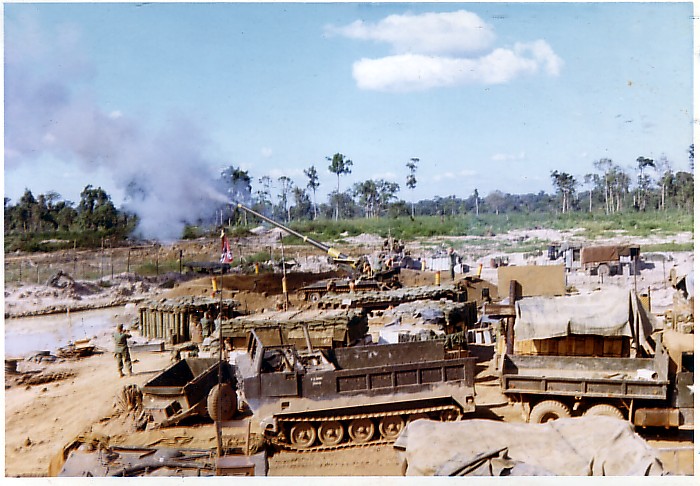
In the 1970’s, when Cambodia was invaded by the then North Vietnamese and Vietcong, thousands of young Khmer men were sent to combat against the more experienced Vietnamese armed forces and thousands of Khmers were killed. Many of my friends who went to fight in the battles--such as in Chenla I, Chenla II, just to name a few--had never returned from the battlefields. Those young men and women were the cream of the crops for the Khmer race. They could have been here with us and produced thousands more offsprings.
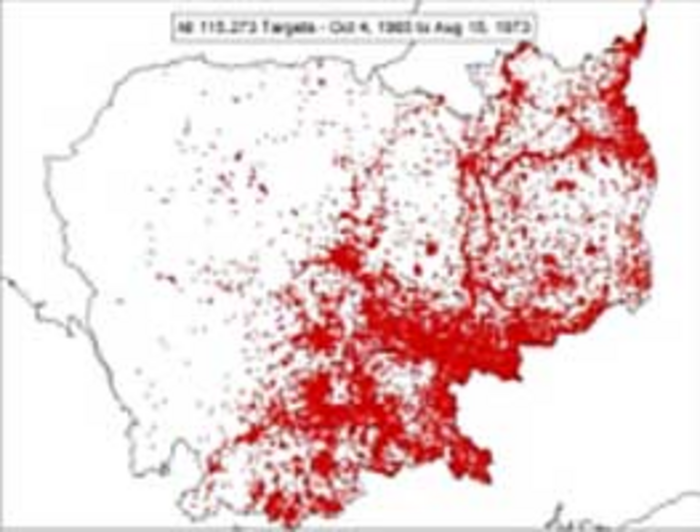
Needless to say, thousands of young Khmer men and women who went to join the Khmer Rouge, the Khmer Roumdos of Prince Sihanouk and the North Vietnamese/Vietcong to battle the Khmer Republican Army were also killed and maimed.  Hundreds of thousands of Khmer lives were destroyed by the American air raids. Millions tons of bomb (http://www.youtube.com/watch?v=88jrZjsNHPc&feature=player_embedded) were used in a few short years. Many of my relatives and friends who went to join in the fight never came back. Those were the cream of the crops of Khmer blood.  They could have been here with us and produced thousands more Khmer children.
Map showing 115,273 targets of U.S. secret bombing of Cambodia between October 1965 and August 1973. (Taylor Owen)

The remaining Khmer young men, women and their family members whom were left over from the 70-75 war--most of them sided with the American-backed government of Lon Nol--were savagely murdered during the Pol Pot rule of 75-79. Some two millions Khmer lives vanished in a few short years.  Most of them were the cream of the crops of Khmer race. If they were here with us, they could have produced millions Khmer families.
                                            From: https:/.../tag/vietnam-invaded-cambodia/

 
Then, the last waves of the killings were during and after the Vietnamese invasion of 1979. Countless of Pol Pot’s soldiers –all Khmer—were sacrificed to fight against the hundreds of thousands well armed Vietnamese invading forces.  Can we imagine, how many Khmers were shot to death by the Vietnamese and how many were maimed and injured? At the same time, the Vietnamese also recruited thousands more of Khmer men and women to fight against the Khmer Rouge guerilla. Countless more Khmers on both sides died in the many battles during and after the Vietnamese invasion.

What about the K5 Plan? During my first visit to Cambodia in 1992, I learned a new “saying” by Cambodian people-Tov Chiss Laan, Mok Vinh Chiss Chaan—it meant when young Khmer men and women were sent to serve in the K5 Plan they went by the truckloads, but when they returned, they (their ashes) came back inside small urns.  Thousands more of Khmers—the cream of the crops—were sacrificed. They could have produced thousands more Khmer families, if they were here with us.
Now, a decade later, the last cream of the crops of Khmer men and women—they are called the Khmer Rouge soldiers, along with the so-called Cambodian Royal Armed forces, who are mostly underprivileged--are about to be sacrificed against the almighty Thailand’s armed forces.  Meanwhile, those children of the rich and powerful ones, many of whom are new comers (can't even enunciate Khmer words), enjoy their time singing in Karaoke bars, eating and drinking in fine restaurants and nightclubs, driving luxurious vehicles, etc…
My Khmer brothers and sisters: Whether you are in Vietnam, in Thailand and elsewhere in the world, let’s us stop fighting against each other.  There are many Thai soldiers who are Khmer as well as there are many Vietnamese soldiers who are Khmer. Let’s furthermore remember that during Vietnam War, many of our Khmer brothers and sisters who lived in Kampuchea Krom were sent to fight into the fierce battlefields. We had killed each other in the battlegrounds throughout Vietnam as well as in Cambodia.  The so-called Mike’s Forces army was nearly wiped out—many thousands of those fine young men and women were Khmer.  They could have produced thousands Khmer families in that region if their lives were spared from the fighting. 
                                   http://www.kneesinthebreeze.com/images/soos/index.html
Now this: By looking at the elements of Thai fighters, I see that many of them are the underprivileged ones. Many of whom are Khmer men and women who are of Thai nationals. They are being positioned to confront their brothers and sisters--Khmer men and women who are also poor and uneducated inside Cambodia. Shall we fight and kill each other again?


                            Source: Cambodian Newspaper Koh Santepheap
Wherever we are, we all are Khmer- Just Khmer—not Khmer Loeur, Khmer Kandal, Khmer Krom, Khmer Krao or Khmer Khnong.  Our Khmer race is being wiped out.  Whether we are being systematically eradicated by others, by our own past ignorance or both, we need to stop the annihilation right now.  

Stop the Killing! One Khmer life is priceless.    

What will Thailand do... Shoot the "foreign" military ataches?

Yellow-shirt activist Veera Somkwamkid (left)
and Democrat MP Panich Vikitsreth

Cambodian move raises border tension

A Cambodian bid to take a group of foreign military attaches into part of the disputed 4.6 square kilometres around Preah Vihear temple has raised tension, again, on the border in Si Sa Ket province, a military source said on Wednesday.

The source said that Thai troops were put on a continuing alert in the 4.6 sq-km area, especially around the Preah Vihear temple, as a precaution, from Tuesday night.

The tension flared after Cambodia informed the Thai soldiers that it planned to bring the military attaches of 10 countries from Phnom Penh into the disputed area on Wednesday. The Thai side denied them permission.

Cambodia wanted the attaches to see important spots, including the damage to Wat Kaeo Sikha Kiri Savara and the area around it, which is in Thai terrority, the source said.

"There would be no problems if the attaches were taken specifically to see Preah Vihear temple,  but we cannot allow them to go into the disputed area which has been occupied by Cambodian soldiers. We also regard the disputed area as ours," said the source.

The source said when Thailand took military attaches of 14 countries to the border in the middle of last month; they were taken to see only Mor E-daeng cliff and Phum Srol village on the Thai side of the border. They did not enter the disputed area.

The rejection caused Cambodia to postpone the visit until Thursday. Thai troops have been put on the alert. It was not known whether Cambodia would persist with the visit or cancel it, the source said.

The source said the Thai military attaché in Phnom Penh had contacted the military attaches of other countries and been told they wanted the visit postponed for fear of sparking a new confrontation between Thailand and Cambodia.

Meanwhile, reports reaching the Thai military said Cambodian Prime Minister Hun Sen had ordered a change to the border forces, replacing the current soldiers with those of the Khmer Rouge.

The source said Khmer Rouge soldiers were viewed as intended more for combat than for promoting a good relationship.

Democrat Party MP Panich Vikitsreth said the health of yellow-shirt activist Veera Somkwamkid, who is imprisoned in Cambodia, is deteriorating.

Mr Panich, one of the seven Thais arrested by Cambodian troops on Dec 29 last year for illegal entry, said Mr Veera had a head injury, skin rashes and respiratory illness due to poor air circulation in his cell.

The MP said he had talked with the mothers of Mr Veera and his secretary Ratree Pipatanapaiboon, who is also detained in Phnom Penh. Both mothers were concerned for Mr Veera and Ms Ratree and wanted them to be released as soon as possible.

The quickest way to get them released was to petition the Cambodian monarch to grant the pair a royal pardon, he said.

Mr Panich said he hoped the case of Mr Veera and Ms Ratree would be treated similarly to the case of Thai engineer Sivarak Chutipong who was granted a royal pardon by Cambodia's King Norodom Sihamoni before serving the usual two-thirds of his sentence.

Mr Sivarak was found guilty of stealing the flight plan of former prime minister Thaksin Shinawatra ahead of his visit to Cambodia in 2009.

The Phnom Penh Municipal Court on Feb 1 jailed Mr Veera for eight years, and Ms Ratree for six years, after they were found guilty of illegal entry and espionage on Dec 29.

Tuesday, March 1, 2011

Secratary Dean Acheson and Preah Vihear


It was then the  former U.S. Secretary of State Dean Acheson who acted as attorney for Cambodia in the country's legal battle in the International Court of Justice with Thailand over the ancient border temple of Preah Vihear.

Turning Adversity to Avantage

Napoleon Hill says "definiteness of purpose is the starting point of all achievement," and my personal definiteness of purpose...