Sunday, March 13, 2011

Learn About Our Neighbors: South Thai Troubles

Euraisa Reviews

South Thai troubles ‘not religious issue’

Written by: UCAN
 
 
Worsening violence afflicting three predominantly Malay-Muslim southern provinces of Thailand is not about religion but about basic human rights, Church people and activists say.

“There is great dissatisfaction among local (Muslim) people due to actions of government officials – arbitrary detention, torture and worse. When they are proven innocent, they were released without compensation,” said Sarawut Prathumraj, former board member of the catholic bishops’ Catholic Commission of Justice and Peace.

Government officers “who violate the local people’s human rights seem to enjoy impunity,” he charged, adding that the situation is complex. “For the local mafia selling illegal products, the almost daily bombings and killings and tension cover up their activities,” added Sarawut, who now works with the International Commission of Jurists (ICJ).

Kalaya Eaiwsakul, a coordinator of Diocese Social Action Center of Surat Thani diocese, said in recent weeks there have been almost daily reports of car bombings or shootings or killing of Buddhist monks on alms rounds.

Nobody seems to be able to stop this despite the presence of tens of thousands of army troops and government-backed militia groups. “The government has really failed in this issue,” said Kalaya, a Buddhist.
A March 8 closed-door meeting of NGO activists in Kuala Lumpur affirmed that religion is not the source of the troubles in the southern Thai provinces of Pattani, Yala and Narathiwat.

“Thailand has freedom of religion. The Thai government has nothing against Islam or Muslims. But what is happening is the denial of the fundamental rights of the individual as well as the right to self-determination of the Malay-Muslim people,” said an activist who works for a Malaysia-based relief agency.
The activist, who only wanted to be known as “Nua,” pointed out that the Malay-Muslims of southern Thailand have been denied expression of their identity and culture, and usage of their language. They have also been losing their traditional lands and local fishermen have been losing their livelihood as fishing concessions were granted to Bangkok-based businesspeople.

Since 2004, the insurgency as well as government and military heavy-handedness have claimed 4,500 lives and left more than 8,000 children orphaned, Nua and other activists said. In the same period, more than 15,000 local people have been arrested and detained, and torture, disappearance and killing of activists and sympathizers have been common.

Nua said at present 60,000 army troops are stationed in the region, in addition to another 60,000 military-backed militias. “Guns and drugs have flooded the region. Some Buddhist temples and government clinics and schools serve as temporary military camps, creating a very tense situation.”

An activist who only wanted to be known as “Wan” said there is no serious attempt to solve the problem because of vested interests. “For example, damaged buildings and infrastructure mean business opportunities for certain people. One dead body means one more business opportunity. Nua added: “More security problems mean more budget channeled to the military.”

On the way forward, Nua said activists have to work with Thai NGOs and civil movements within the scope of the Thai constitution.

Saturday, March 12, 2011

A Year After Protests, Thai Elections Set

A Year After Protests, Thai Elections Set

http://timothychhim.blogspot.com/2011/03/thaksin-is-still-wanted-by-thai.html

Thaksin is still wanted by Thai government and by Thai people


While the Thai government wants X-PM Thaksin to serve his jail term, many Thai people also want Thaksin to come back to lead Thailand.
 
It looks like the conflict in Thailand's color-coded society will go on regardless of who runs Thailand.

As long as the economic and social gap between the elitists and the poor is still wide, the confrontation will continue--at least until one side runs out of money.

Money is still God as well as Evil because it can solve the problems and it can cause the conflicts.

We need to follow the money trails to find the sources of major problems.

On the left is the image of Thaksin at: cpdthai.wordpress.com/


(http://www.time.com/time/world/article/0,8599,2058592,00.html)
 
Now that the election is set, the world will soon find out whether Thailand's democratic processes will be as fair as millions Thai people want to see. Will the red shirts and their allies have enough funding and political will to campaign against the yellow shirts, Abhisit, Thai military and His Majesty the King?  


Sambath Meas: Can Khmers Sue Sdech Thai (King Bhumibol Adulyadej...

Sambath Meas: Can Khmers Sue Sdech Thai (King Bhumibol Adulyadej...: "Picture of Phum Srol village chief Virayut Duangkaew from the Bangkok Post. Here is the news from the Bangkok Post, which was reported by ..."

"Silence is not necessarily golden"

Thai Villagers sue Cambodia for 2,239,905,000 Baht.

http://www.pattayadailynews.com/en/2011/03/12/thai-villagers-sue-cambodia/

It is very interesting!

The Pattaya Daily News reported Thai villagers sue Cambodia for 2,239,905,000 Bahts for their damages, but the pictures used in the article showing the damages done to Wat Khmer by the Thais. Please click :
http://www.pattayadailynews.com/en/2011/03/12/thai-villagers-sue-cambodia/ or click on the title for the report.

Khmer people who are victimized by Thailand's gun power in Cambodia should do the same thing--sue Thailand and those warmongers who instigated the fight.

While Cambodia receives funding from international donors to survive, Thailand has enough money to pay all Khmer victims.The richest Monarch on this planet is also the Thai King.
(http://www.foxnews.com/story/0,2933,408645,00.html)

Let's hope that His Majesty will not let Thailand down and would help the victims and help stop the yellow shirts and Thai Army from their madness.

Meanwhile the damages to the Khmer Temple of Preah Vihear is immeasurable. No amount of Thai Baht can help rebuild or repair the loss.


http://www.cam111.com/photonews/2011/02/10/77329.html

Friday, March 11, 2011

A magnitude 8 earthquake releases 6 million tons of TNT

How Are Earthquake Magnitudes Measured?


The Richter Scale

Figure 1 - Charles Richter studying a seismogram.

Figure 1 - Charles Richter studying a seismogram. The magnitude of most earthquakes is measured on the Richter scale, invented by Charles F. Richter in 1934. The Richter magnitude is calculated from the amplitude of the largest seismic wave recorded for the earthquake, no matter what type of wave was the strongest.


The Richter magnitudes are based on a logarithmic scale (base 10). What this means is that for each whole number you go up on the Richter scale, the amplitude of the ground motion recorded by a seismograph goes up ten times. Using this scale, a magnitude 5 earthquake would result in ten times the level of ground shaking as a magnitude 4 earthquake (and 32 times as much energy would be released).


To give you an idea how these numbers can add up, think of it in terms of the energy released by explosives: a magnitude 1 seismic wave releases as much energy as blowing up 6 ounces of TNT.

A magnitude 8 earthquake releases as much energy as detonating 6 million tons of TNT. Pretty impressive, huh? Fortunately, most of the earthquakes that occur each year are magnitude 2.5 or less, too small to be felt by most people.


The Richter magnitude scale can be used to desribe earthquakes so small that they are expressed in negative numbers. The scale also has no upper limit, so it can describe earthquakes of unimaginable and (so far) unexperienced intensity, such as magnitude 10.0 and beyond.

Although Richter originally proposed this way of measuring an earthquake's "size," he only used a certain type of seismograph and measured shallow earthquakes in Southern California. Scientists have now made other "magnitude" scales, all calibrated to Richter's original method, to use a variety of seismographs and measure the depths of earthquakes of all sizes.

Here's a table describing the magnitudes of earthquakes, their effects, and the estimated number of those earthquakes that occur each year.

The Mercalli Scale

Figure 2 - Giuseppe Mercalli


Figure 2 - Giuseppe Mercalli Another way to measure the strength of an earthquake is to use the Mercalli scale. Invented by Giuseppe Mercalli in 1902, this scale uses the observations of the people who experienced the earthquake to estimate its intensity.


The Mercalli scale isn't considered as scientific as the Richter scale, though. Some witnesses of the earthquake might exaggerate just how bad things were during the earthquake and you may not find two witnesses who agree on what happened; everybody will say something different. The amount of damage caused by the earthquake may not accurately record how strong it was either.


Some things that affect the amount of damage that occurs are:

the building designs,

the distance from the epicenter,

and the type of surface material (rock or dirt) the buildings rest on.

Different building designs hold up differently in an earthquake and the further you are from the earthquake, the less damage you'll usually see. Whether a building is built on solid rock or sand makes a big difference in how much damage it takes. Solid rock usually shakes less than sand, so a building built on top of solid rock

Vietnam + Cambodia Vs Thailand-- What country will be smushed?

http://english.vovnews.vn/Home/Vietnam-Cambodia-ink-plan-for-defence-cooperation/20113/124655.vov

Vietnam, Cambodia ink plan for defense cooperation

Vietnam and Cambodia have agreed a plan for bilateral cooperation in defense in 2011 in Siem Reap city. 
Present at the signing ceremony on March 9 were visiting Vietnamese Defense Minister General Phung Quang Thanh and Cambodian Deputy Prime Minister and Defense Minister General Tea Banh.

The same day, the two sides held talks on bilateral cooperation in 2010.

The Vietnamese side highly appreciated the results of defense cooperation with Cambodia over the past year, especially protecting border security and fighting drug trafficking.

Minister Thanh stressed on Cambodia’s active and effective assistance in searching and repatriating the remains of Vietnamese volunteer soldiers who had sacrificed their lives in Cambodia.

He said the Vietnamese government always wants Cambodia to soon stabilize the border situation in the long-term interests of neighbouring countries.

The Cambodian side agreed with Vietnam on defense cooperation in the coming time, particularly on human resource training.

Minister Tea Banh asked the Vietnamese side to accelerate friendship visits between units of the two armies to share experiences in the field.

The two sides agreed to continue boosting cooperation as mentioned in the protocol signed between the two ministries in 2009.

During the visit from Mar. 9-11, the Vietnamese defence delegation will visit the Ku Len War Invalids Centre 317 and the Cambodia-Vietnam Friendship Non-Commissioned Officers’ School under the Cambodian Royal Army’s Military Zone 4.

VOVNews/VNA

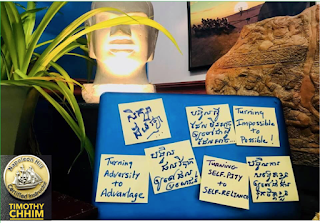
Turning Adversity to Avantage

Napoleon Hill says "definiteness of purpose is the starting point of all achievement," and my personal definiteness of purpose...